

ResearchEmotion Engineering
What is Affective Experience?
2025년 5월 26일
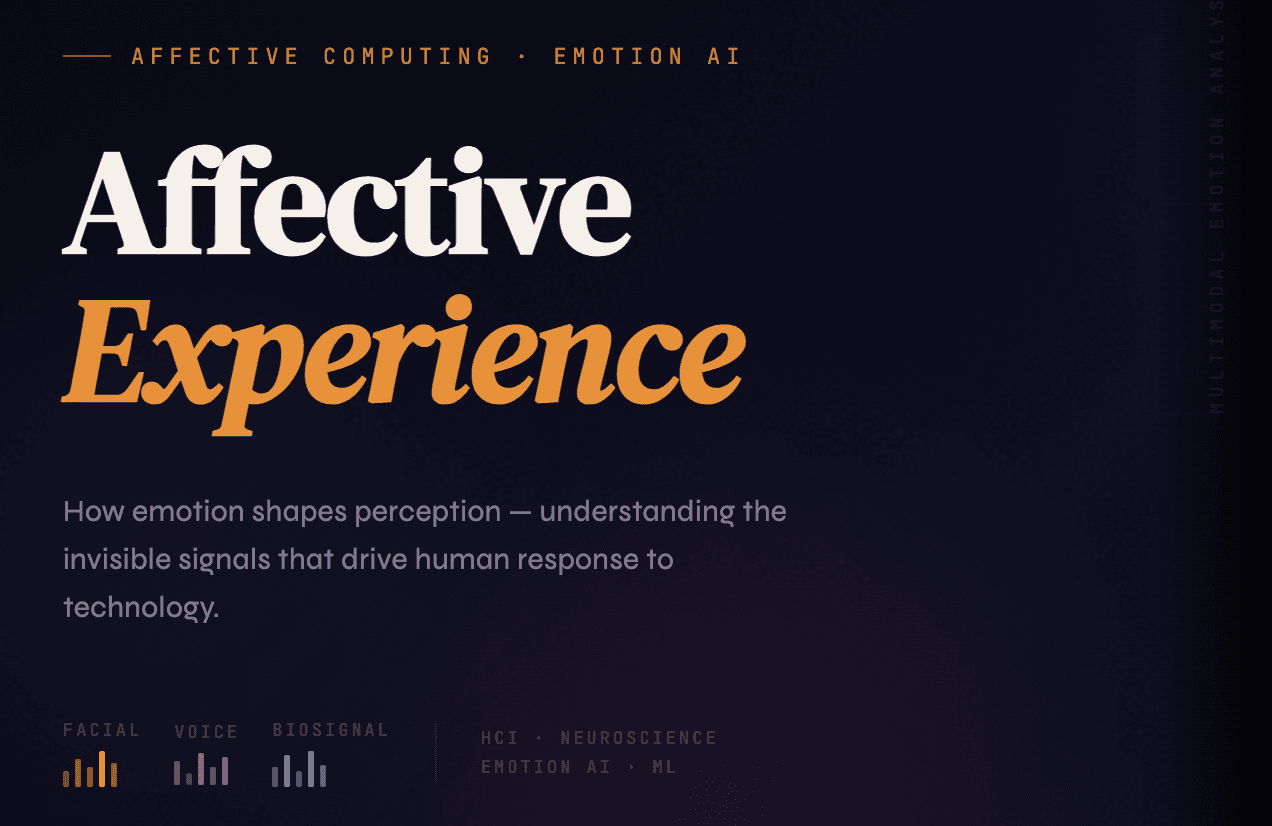
When we interact with technology, our experience is not determined only by functionality or usability. What truly shapes our perception of a product or service is often how it makes us feel. This emotional dimension of interaction is what researchers describe as affective experience.
Affective experience refers to the emotional and physiological responses that occur while a person interacts with a system, environment, or piece of content. It encompasses subtle feelings such as comfort, engagement, tension, curiosity, or frustration. These responses are not always consciously recognized by users, yet they strongly influence decision-making, satisfaction, and long-term behavior.
Traditionally, user experience research relied heavily on self-report methods such as surveys and interviews. While these approaches remain useful, they have an inherent limitation: people cannot always accurately describe their emotional state. Many affective reactions occur automatically and outside conscious awareness.
Advances in affective computing and emotion AI are beginning to change this landscape. Researchers can now analyze emotional responses through a combination of behavioral and physiological signals. Facial expressions captured by computer vision models reveal micro-expressions linked to emotional states. Voice patterns provide cues about stress, confidence, or engagement. Physiological signals such as heart rate variability or skin conductance reflect autonomic nervous system activity associated with emotional arousal.
When these signals are analyzed together, they allow researchers to estimate a user's affective state during real interactions with digital products, advertisements, or immersive environments.
This approach represents a shift from subjective evaluation to data-driven emotional measurement. Instead of asking users how they felt after an experience, researchers can observe emotional responses as they unfold in real time. Such measurements provide deeper insight into moments of confusion, excitement, cognitive overload, or immersion.
Understanding affective experience is particularly important in areas where emotional engagement directly shapes outcomes. Digital media, gaming, marketing, education, and immersive technologies such as XR all rely on emotional responses to drive user engagement. A design that is technically functional but emotionally flat often fails to capture sustained attention.
For designers and developers, this means that evaluating a system solely in terms of usability is no longer sufficient. Modern interaction design increasingly focuses on how a product influences emotional states over time. Affective experience becomes a key dimension of product quality.
From a research perspective, affective experience sits at the intersection of several disciplines. Psychology contributes theories of emotion and cognition. Neuroscience explains the physiological mechanisms underlying emotional responses. Human-computer interaction provides frameworks for studying user behavior. Machine learning enables large-scale analysis of multimodal emotional signals.
The convergence of these fields is driving the emergence of multimodal emotion analysis, where multiple data sources—facial expressions, biosignals, voice, and behavioral logs—are integrated to interpret human emotional responses more accurately.
As artificial intelligence systems become increasingly embedded in everyday life, understanding affective experience will become even more critical. Technology is no longer just a tool; it is an interactive partner that influences how people think, feel, and behave.
For researchers and builders of AI systems, the key question is no longer simply whether a system works. The deeper question is how people experience that system emotionally.
Affective experience provides a framework for answering that question.
이 주제에 대해 더 알아보기:
참고 자료 보기