

ResearchEmotion Engineering
The Structure of Emotion III: Social Emotion and Context-Based Feelings
2025년 6월 23일
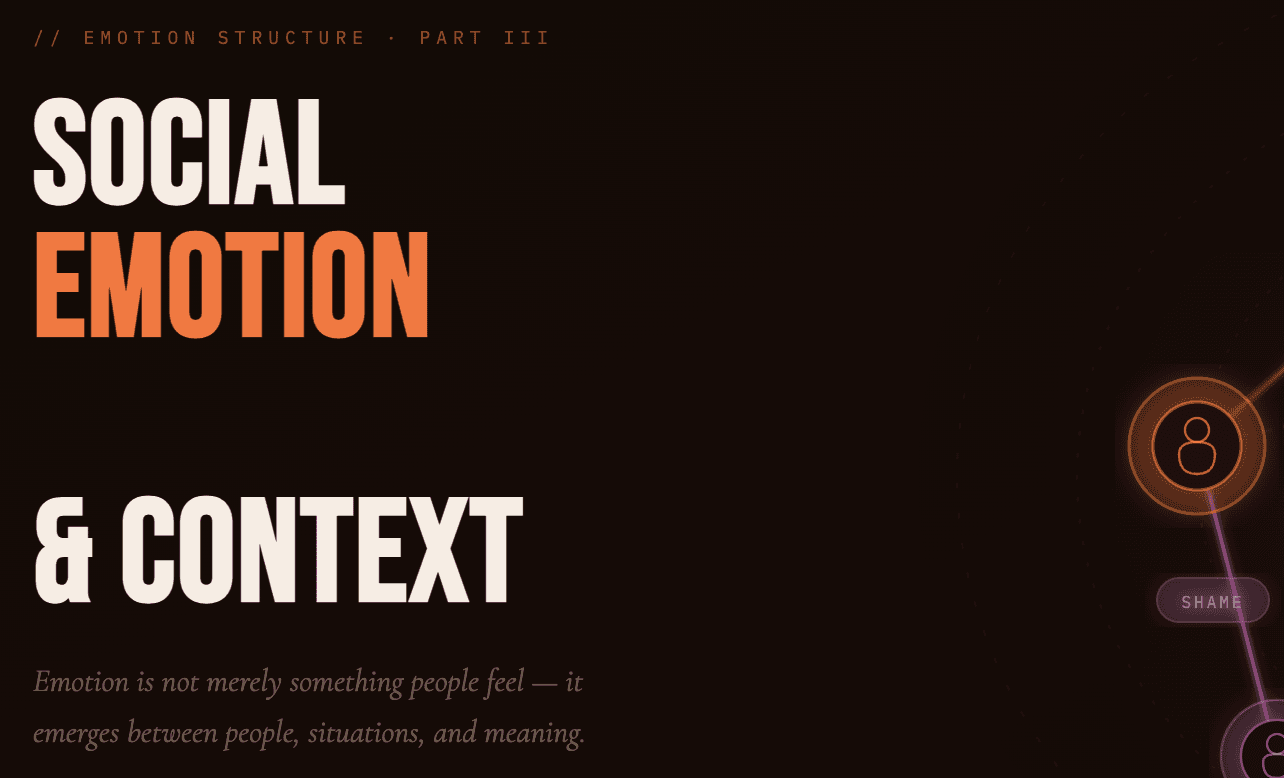
The word emotion appears frequently in everyday language, yet it becomes surprisingly difficult to define when we try to explain it precisely. We often refer to an “emotional atmosphere” or describe someone as having an “emotional reaction,” but emotions are not simply internal responses that arise within an individual.
Emotional experience is deeply shaped by social relationships and cultural context. Feelings emerge through interactions with others, and their meaning is often interpreted through shared norms, expectations, and social signals. Affective engineering increasingly seeks to understand how emotions arise within these broader contexts and how they can be incorporated into the design of technology and products.
To fully understand emotional experience, it is necessary to move beyond purely physiological or individual explanations and examine how emotions are constructed through social interaction and contextual interpretation.
Many emotions are inherently social. These are often referred to as social emotions, meaning emotional states that arise from our relationships with others. Feelings such as shame, guilt, pride, jealousy, and empathy are difficult to explain purely in terms of physiological reactions. Instead, they depend heavily on how we perceive the judgments, expectations, and behaviors of other people.
For example, shame typically arises when an individual believes they have violated a social norm and imagines how others might perceive that violation. Pride, in contrast, often emerges when someone feels recognized or valued within a social group. These emotions are therefore deeply tied to social awareness and interpersonal evaluation.
Social emotions also play a critical role in emotional intelligence. The ability to recognize the emotional states of others and regulate one’s own reactions accordingly is often described as a core component of emotional intelligence (EQ). In social and organizational environments, this ability shapes communication, collaboration, and trust.
From the perspective of affective engineering, these dynamics raise an important question: how do products, interfaces, and digital environments influence social emotions?
Technological systems do not exist in isolation from social meaning. A product may evoke pride, belonging, or status depending on how it is perceived within a social context. For example, the design of a car may signal prestige or identity, while the interface of a social media platform may encourage empathy, recognition, or social validation. Understanding these emotional dynamics allows designers to create experiences that resonate with users on a deeper level.
Context also plays a crucial role in shaping emotional interpretation. The same stimulus can lead to completely different emotional responses depending on the surrounding circumstances. A joke shared among close friends may produce laughter and warmth, while the same remark in a professional meeting could be interpreted as disrespectful or inappropriate.
This illustrates an important principle: emotions are not simply triggered by stimuli. Instead, they emerge through interpretation within context. Situational factors such as environment, relationships, expectations, and cultural norms influence how emotional signals are understood.
For designers and researchers working in user experience and affective computing, this insight has significant implications. Emotional analysis based solely on physiological signals or facial expressions can provide valuable data, but it may not capture the full meaning of emotional experience. Contextual information—such as where a user is, what they are doing, and who they are interacting with—often plays an equally important role.
Recent developments in emotion recognition technology increasingly reflect this shift. Instead of relying on a single signal such as facial expression or heart rate, modern systems attempt to integrate multimodal signals and contextual data. Environmental information, interaction patterns, and social cues are combined with physiological data to generate a more comprehensive understanding of emotional states.
In this sense, emotion should not be viewed as a static signal but as part of a dynamic network of meaning. Emotional responses evolve over time and are shaped by personal memory, cultural background, and social interpretation. The same physiological reaction may carry very different meanings depending on the individual and the situation.
Affective engineering seeks to incorporate these layers of complexity into the design of human-centered technology. Rather than treating emotion as a simple measurable variable, researchers increasingly view emotional experience as a relational and contextual phenomenon.
This perspective also expands the role of emotion in design. Affective engineering does not focus solely on measuring emotional reactions; it also explores how emotional responses can be intentionally shaped through design decisions. Social emotions, in particular, can be influenced through elements such as brand identity, visual design, interface tone, and interaction patterns.
Consider the example of social media platforms. Features such as “likes,” reactions, and emojis are designed to stimulate feelings of recognition, empathy, and belonging. Community platforms often incorporate mechanisms that reinforce group identity and social participation. These design choices influence how users perceive themselves and others within a digital environment.
Similarly, product design can evoke social emotions such as pride, prestige, or trust. A premium product aesthetic may communicate status and self-expression, while carefully designed notification messages on wearable devices may encourage empathy or reassurance.
As affective engineering continues to evolve, the field is expanding beyond purely technical considerations. Cultural context, ethical implications, and social responsibility are increasingly recognized as essential components of emotional design. Feelings such as being respected, valued, or socially connected can strongly influence brand loyalty and long-term user relationships.
Emotion, therefore, can no longer be understood solely as a physiological reaction or a neural process within the brain. Emotional experience emerges through relationships, evolves through context, and acquires meaning through interpretation.
Affective engineering represents an attempt to understand this complex structure and translate it into technological design. By analyzing emotional signals within their social and contextual environments, researchers can develop systems that respond more intelligently to human needs.
Understanding social emotion and context-based feeling is therefore a key step toward creating more precise user experiences and more human-centered technologies.
Emotion is not merely something people feel. It is something that emerges between people, situations, and meaning.
And increasingly, it is something that technology must learn to understand.
이 주제에 대해 더 알아보기:
참고 자료 보기