

ResearchEmotion Engineering
The Structure of Emotion II: Dimensional Models and Emotion Maps
2025년 6월 16일
The concept of emotion is frequently used in everyday language, yet it often becomes vague when we attempt to define it precisely. We speak of “emotional people” or “emotionally engaging content,” but emotion is far more complex than a simple mood or preference.
Affective engineering aims to transform this ambiguity into structured and analyzable knowledge. Researchers have proposed multiple ways to describe the structure of emotion, and one of the most influential approaches is the dimensional model of emotion. Instead of treating emotions as fixed categories, this framework attempts to represent emotional experience within a continuous space—much like coordinates on a map.
This perspective provides a powerful way to visualize, analyze, and quantify emotional states.
Emotions are remarkably diverse and often difficult to separate into clearly defined categories. Experiences such as joy and calmness, or anxiety and anger, are related but not identical. Traditional categorical approaches sometimes struggle to capture these subtle differences. As a result, researchers began exploring ways to describe emotions not as discrete labels but as positions within a multidimensional space.
This shift gave rise to the idea of representing emotions using coordinates rather than names.
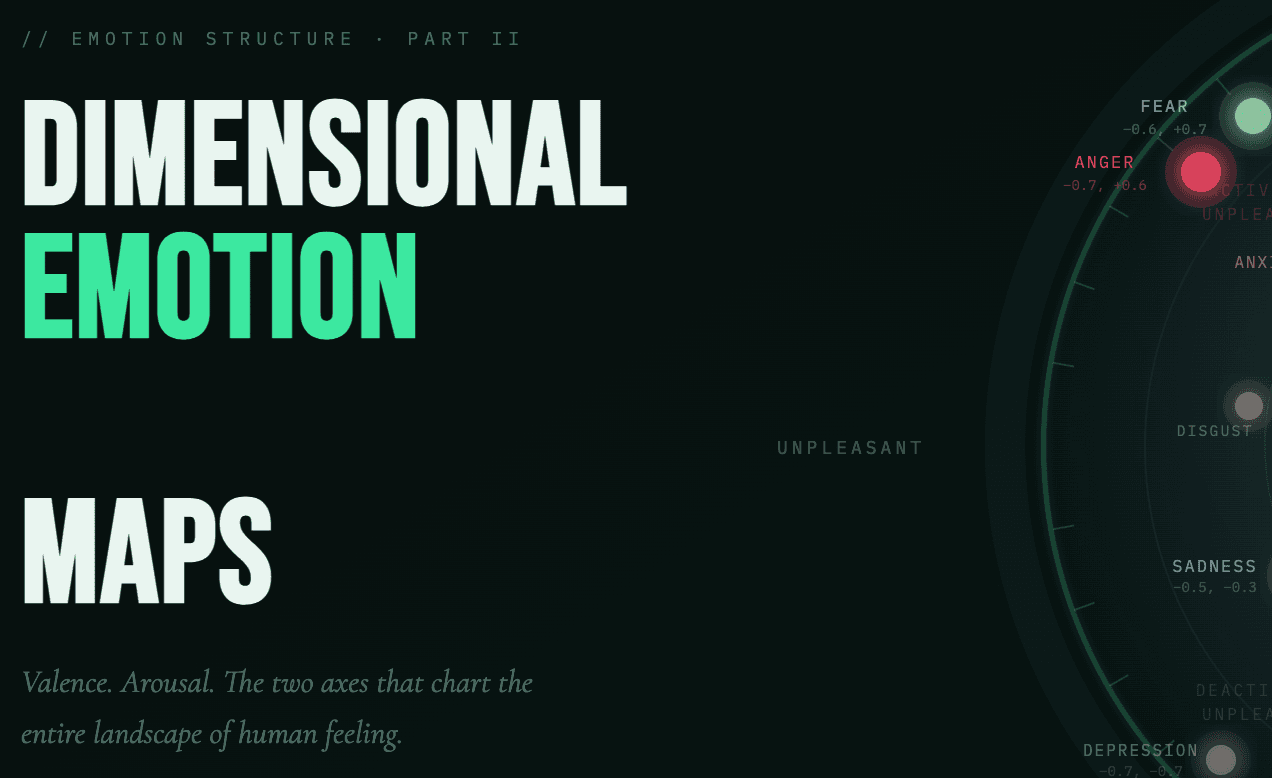
One of the most influential models within this framework was proposed by psychologist James Russell, known as the Circumplex Model of Emotion. Russell suggested that emotional experience can be organized along two primary dimensions. The first dimension is valence, which represents the spectrum between pleasant and unpleasant feelings. The second dimension is arousal, which reflects the level of activation or physiological intensity, ranging from calm to excited.
When these two dimensions are combined, they form a circular emotional space in which different emotional states can be positioned as coordinates. For example, joy typically corresponds to high valence and high arousal, while depression is characterized by low valence and low arousal. Calmness represents high valence with low arousal, whereas anger often combines negative valence with high arousal.
This structure allows emotions to be visualized as locations within a continuous emotional landscape.
One of the key advantages of the dimensional model is its ability to illustrate relationships between emotional states. Emotions that are conceptually similar tend to appear close together in the emotional space, while those that are very different appear far apart. Irritation and anger occupy nearby regions, whereas calmness and excitement lie in distant parts of the map.
Because emotional states can move within this space over time, the dimensional framework also makes it possible to track emotional dynamics. Instead of representing emotion as a fixed label, it becomes a point that shifts continuously as circumstances change.
This perspective differs significantly from the basic emotion model discussed in the previous article. The basic emotion framework focuses on identifying distinct emotional categories, often grounded in universal facial expressions. Research by Paul Ekman suggested that emotions such as happiness, sadness, anger, surprise, fear, and disgust could be recognized across cultures through characteristic facial muscle patterns.
The dimensional model, however, takes a different starting point. Rather than focusing primarily on facial expressions, it examines the structure of emotional language and subjective experience. Russell’s circumplex model emerged from the analysis of emotional vocabulary and how people describe their feelings. Large sets of emotional terms were analyzed and found to cluster systematically along the axes of valence and arousal.
This approach highlights the interpretive richness of emotional experience. While facial expressions capture certain biological signals, emotional language reflects how individuals interpret and describe those internal states.
Another important distinction lies in how the two frameworks conceptualize emotional boundaries. The basic emotion model treats emotional categories as relatively discrete units. In contrast, the dimensional model views emotions as continuous and fluid. The boundary between irritation and anger, for instance, is not fixed but depends on context and intensity.
This flexibility makes the dimensional model particularly useful for applications that require nuanced emotional analysis.
In affective engineering, dimensional emotion models are widely used to translate emotional responses into measurable coordinates. Instead of labeling a user’s state simply as “happy” or “sad,” emotional responses can be represented by their position along valence and arousal axes. For example, irritation might appear as moderately negative valence with relatively high arousal, while calmness might correspond to positive valence with low arousal.
This coordinate-based representation allows emotional states to be visualized and compared across time, users, or interaction contexts.
Physiological signals play an important role in connecting emotional coordinates to measurable data. Heart rate variability, skin conductance, and brain activity can provide indicators of emotional arousal, while facial expressions and voice tone can contribute to estimates of emotional valence. By combining these signals, researchers can infer a user’s approximate location within the emotional space.
This approach enables real-time emotional analysis in fields such as user experience research, immersive media, and human–computer interaction.
The dimensional model also provides a foundation for constructing emotion maps, visual representations that track emotional changes across an interaction. These maps can illustrate how users move through emotional states while interacting with a product, service, or digital environment. Peaks in arousal may correspond to moments of excitement or frustration, while shifts in valence may reveal satisfaction or disappointment.
For designers and engineers, emotion maps offer valuable insights into how experiences unfold over time. Instead of relying solely on retrospective surveys, researchers can observe emotional trajectories as they occur during an interaction.
This capability opens new possibilities for designing emotionally responsive systems. User interfaces, digital content, and interactive technologies can be developed with the goal of guiding users toward desired emotional states. Emotional experience thus becomes not only measurable but also designable.
From the perspective of affective engineering, emotion is no longer treated as an abstract and subjective phenomenon. Instead, it becomes a structured form of data that can be modeled, visualized, and integrated into technological systems.
While the basic emotion model introduced a way to categorize emotional expressions, the dimensional model provides a framework for understanding emotional experience as a continuous landscape. Together, these approaches form complementary tools for interpreting human affect.
As emotion-sensing technologies continue to evolve, these models help translate the complexity of human feelings into signals that machines can interpret.
Emotion is gradually becoming a language that can be measured, mapped, and designed.
이 주제에 대해 더 알아보기:
참고 자료 보기